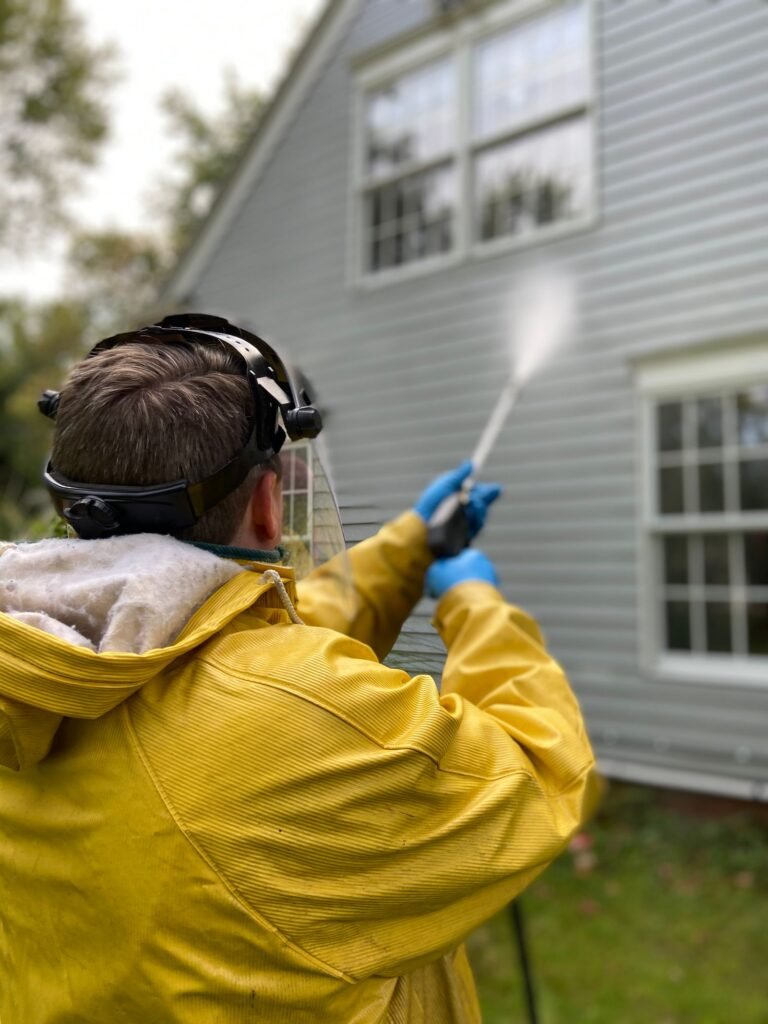
Can Pressure Washing Damage Vinyl Siding?
High pressure can force water behind vinyl siding, causing mold and hidden damage. Here is the safe way to clean siding in Jacksonville’s humid climate.
✓ Licensed & Insured
✓ COI Available
✓ Locally Owned
✓ Free Quotes
Can Pressure Washing Damage Vinyl Siding?
Yes. The main danger is forcing water up behind the panels through weep holes and seams, where it gets trapped and feeds mold and rot. Vinyl is built to shed water running downward, not to resist water driven sideways or upward at pressure. The safe method is soft washing: low pressure plus solutions that kill growth at the root.
How Water Gets Behind Vinyl Siding
Vinyl siding is a rain screen, not a waterproof barrier. Panels hang loosely so water behind them can drain out the bottom through small slots called weep holes — designed to let moisture escape, not to keep pressurized water out.
A pressure washer breaks that design. Aim it at the wrong angle and the jet forces water upward through the weep holes, sideways through overlapping panel seams, and around the J-channel framing windows and doors — plus soffit vents under the eaves. In every case the water lands where it should never go: inside the wall cavity, against the sheathing and framing.
That is when Jacksonville’s climate turns a mistake into a real problem. Local climate data shows roughly 100+ rainy days a year and around 75% average humidity, with temperatures frequently over 80°F. Water trapped behind siding in those conditions does not dry quickly — and trapped moisture in heat and humidity is exactly what mold and mildew need to take hold.
The trouble is that water intrusion is invisible at first. The exterior looks clean and bright right after the wash. The damage — mold inside the wall, sheathing starting to soften — shows up months later as musty odors or discoloration bleeding through. By then, a cheap cleaning job has become an expensive repair.
What Kind of Damage Can High Pressure Cause?
Water intrusion is the headline risk, but high pressure causes other damage too:
- Cracked or punctured panels. A narrow nozzle tip concentrates the jet into a cutting stream. Replacing damaged siding is not a small job — homeowners report average repair bills around $900, roughly triple the cost of a professional wash.
- Streaking and discoloration. Bleach mixed too strong, or water forced behind panels unevenly, can leave visible blotches that no amount of rinsing fixes.
- Damage to metal finishes. One vector most homeowners never consider: overly strong bleach mixes can permanently damage the finish on anodized aluminum window frames.
- Buckling and warping. Heat combined with pressure can distort panels so they no longer sit flat.
- Water-stained trim and soffits. Drive water behind J-channel and trim, and staining shows up as dark lines around windows and doors.
The manufacturers warn against it. Vinyl siding maker CertainTeed states plainly: “We do not recommend power washing vinyl or polymer siding as it can cause moisture intrusion, damage, and/or discoloration.” When the company that makes the product says not to do it, that settles the argument.
What a Proper Soft Wash Looks Like, Step by Step
Soft washing is the industry-standard safe method for vinyl siding. It uses water pressure similar to a garden hose combined with cleaning solutions — mostly water with around 2% sodium hypochlorite and a surfactant that helps it cling. The chemistry does the cleaning; the water just rinses. Bleach is not a cleaner here, it is a biocide: it kills mold, algae, and mildew at the root.
Here is what a proper soft wash visit looks like:
- Inspection. The tech walks the house, notes siding condition and loose panels, and identifies landscaping that needs protection.
- Landscaping prep. All plants near the house get thoroughly pre-wet with plain water. Wet foliage absorbs less cleaning solution — and with pre-wetting, the roughly 2% dilutions professionals use are reported as plant-safe.
- Solution application. The cleaning mix goes on at low pressure, section by section, from the bottom up. Nothing gets blasted — the solution clings to the siding.
- Dwell time. The solution sits and works, killing growth at the root. This is the step pressure-only washing skips entirely — and the reason soft-washed siding stays clean substantially longer.
- Gentle rinse. Everything gets rinsed top-down at low pressure. The wand is never aimed upward at the siding — the angle that drives water behind panels.
- Post-rinse. Landscaping, windows, and any exposed metal get rinsed with fresh water to wash away residue.
The whole point is restraint: the lowest effective pressure plus the right detergent. That is the mark of a professional — and the opposite of what damages siding.
Can I Clean Siding Without a Pressure Washer at All?
Yes — and many longtime homeowners do exactly that. People who have maintained vinyl siding for decades describe three recurring methods:
- Garden hose plus house-wash concentrate. A hose-end sprayer with a vinyl-safe house wash, applied from the ground. This is CertainTeed’s own recommended approach for cleaning vinyl siding.
- Pump sprayer plus diluted bleach and water. Spray it on, give it dwell time, agitate stubborn spots with a soft brush on an extension pole, and rinse with a garden hose.
- Spray-and-leave treatments. No-rinse products that work over days and weeks. Caution from homeowner reports: even products labeled “plant-safe” have burned foliage in some cases — protect landscaping during application.
Why hire a pro, then? Reach and chemistry. A garden hose cannot safely clean a second story, and consumer-strength mixes are weaker than professional solutions, so growth comes back faster. A pro soft wash covers the whole house in one visit and kills growth at the root — and carries insurance if anything goes wrong.
Questions to Ask Before You Hire
Before anyone touches your siding, ask these five questions:
- What method do you use on vinyl siding — soft wash or pressure wash? The pro tell is “lowest effective pressure plus the right detergent.” If they cannot explain the difference, keep looking.
- Do you use cleaning solutions, or just water? Companies advertising “no chemicals” often substitute pressure for chemistry — and that is how siding gets water forced behind it.
- How do you protect my landscaping? You want to hear “pre-wet and post-rinse,” not a shrug.
- Are you insured? If a panel cracks or water gets inside the wall, insurance separates a quick fix from your problem.
- How do you handle windows and metal trim? Overly strong bleach damages anodized aluminum finishes — a real pro knows the safe dilution and rinses thoroughly.
Frequently Asked Questions
Will soft washing kill my plants?
Professional soft washing uses roughly 2% sodium hypochlorite dilutions. Reputable companies pre-wet all landscaping with plain water before applying solution and post-rinse everything afterward — with that protection, pros report the application as plant-safe. If you DIY, cover shrubs with plastic sheeting and rinse thoroughly when finished.
How often should vinyl siding be cleaned in Jacksonville?
Every 12 to 18 months for most homes. Shaded lots, waterfront properties, and homes with heavy tree cover may need cleaning every 6 to 12 months because growth is faster there. Watching for visible streaking or discoloration is a more reliable signal than a fixed calendar schedule.
Can I just use a garden hose instead?
For light dirt on ground-level areas, yes — a garden hose with house-wash concentrate works, and it is CertainTeed’s own recommended method for vinyl. But a hose cannot safely reach a second story, and consumer mixes are weaker, so growth returns faster. A professional soft wash treats the whole house and kills growth at the root.
What does the siding manufacturer say about pressure washing?
Vinyl manufacturer CertainTeed states: “We do not recommend power washing vinyl or polymer siding as it can cause moisture intrusion, damage, and/or discoloration.” A gentle approach — hose washing or professional soft washing — is what they recommend for vinyl siding instead.
Is it true that some companies clean siding with “no chemicals”?
Some advertise it, and industry veterans flag it as a warning sign. Without cleaning solution, the only way to get siding clean is more pressure — and more pressure is exactly what forces water behind panels. “Lowest effective pressure plus the right detergent” is the mark of a real professional.
CTA: Worried about your siding? Get a free quote from First Coast Power Washing — Jacksonville’s soft wash specialists. Low pressure, the right chemistry, zero damage.